

How To Set Shutter Speed On Canon
You tin accommodate aperture and shutter speed just in the advanced exposure modes on your Canon EOS 70D. To see the electric current exposure settings, printing the shutter button halfway. The following deportment then take place:
-
The exposure meter comes to life. If autofocus is enabled, the autofocus mechanism starts to do its thing.
-
The aperture and shutter speed appear in the viewfinder, LCD panel, and the Shooting Settings display. In Alive View mode, the settings appear at the bottom of the monitor, assuming that you're using a display mode that reveals shooting data. (Press the Info push to cycle through the Live View display modes.)
-
In manual exposure (One thousand) style, the exposure meter lets you know whether the current settings will expose the image properly. In the other modes, the camera indicates an exposure problem by flashing the shutter speed or the f-terminate value.
The technique y'all use to change the exposure settings depends on the exposure mode:
-
P (programmed autoexposure): The photographic camera displays its recommended aperture and shutter speed. To select a different combination, rotate the Main punch. But notation that your change applies only to the current shot. As well — and this is a critical bespeak — you tin't stray from the initial shutter speed and aperture when you use flash.
-
Television (shutter-priority autoexposure): Rotate the Chief dial to change the shutter speed. As yous do, the camera adjusts the aperture as needed to achieve the proper exposure.
Changing the aperture also changes depth of field. And then even though y'all're working in shutter-priority style, keep an eye on the f-stop, too, if depth of field is important to your photo. Also remember that if the aperture value blinks, the photographic camera can't adapt the aperture enough to produce a good exposure at the current shutter speed. So you may demand to compromise on shutter speed (or, in dim lighting, raise the ISO).
-
Av (aperture-priority autoexposure): Rotate the Main dial to set the f-stop. The camera automatically adjusts the shutter speed.
The range of possible f-stops depends on your lens and, with most zoom lenses, on the zoom position (focal length) of the lens. For the 18–135mm kit lens, for example, yous can select apertures from f/3.5 to f/22 when zoomed to the shortest focal length (18mm). At the maximum focal length (135mm), the discontinuity range is from f/5.6 to f/36.
If you're handholding the camera, be careful that the shutter speed doesn't drib then low that you run the chance of camera milkshake. If your scene contains moving objects, brand sure that the shutter speed is fast enough to stop activity (or ho-hum enough to mistiness it, if that's your creative goal).
-
M (manual exposure): Select aperture and shutter speed like and so:
-
To conform shutter speed: Rotate the Main dial.
-
To suit discontinuity: Rotate the Quick Control dial.
-
-
B (Bulb exposure): Rotate the Main dial to set the f-stop. You control shutter speed through the shutter push: The shutter remains open equally long every bit you hold the push down.
-
C (Camera User Settings) manner: Use the same technique as for the exposure mode you used as the basis for your custom way. For example, if yous based the C mode on the Av mode, you lot tin can adjust f-finish by rotating the Main dial.
You also tin use the Quick Control screen to adjust settings in all these modes except P. First, choose the setting y'all want to adjust. For case, in the following figure, the aperture setting is highlighted, and the proper name of the option appears at the bottom of the screen. Rotate the Main punch or Quick Control dial to adjust the setting. You also can tap the f-stop or shutter speed to display a screen with a setting scale; drag your finger along the scale or tap the arrows above it to adjust the setting. Press the return arrow or the Set button to get out the screen.
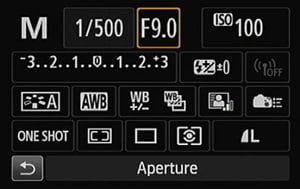
Go on in listen that when you lot use P, Tv set, and Av modes, the settings that the camera selects are based on what it thinks is the proper exposure. If you lot don't concur with the photographic camera, y'all can switch to manual exposure (Yard) mode and simply dial in the aperture and shutter speed that evangelize the exposure you desire.
Virtually This Article
This article is from the book:
- Catechism EOS 70D For Dummies ,
This commodity tin be constitute in the category:
- Catechism ,
Source: https://www.dummies.com/article/home-auto-hobbies/photography/cameras/canon/how-to-adjust-aperture-and-shutter-speed-on-a-canon-eos-70d-158276/
0 Response to "How To Set Shutter Speed On Canon"
Post a Comment